By Juliana Calcao
What was once a raptor’s feeding grounds or its sleeping quarters is now a human’s backyard. Suddenly, the winged animal is no longer a welcome visitor but an intruder. A scenario that speaks to a modern issue: humans encroaching on wild animals’ habitats.
Located in Hampton Bays, in Suffolk County, the Evelyn Alexander Wildlife Rescue Center rehabilitates wild animals impacted by habitat encroachment.
Creatures that cannot be returned to the wild either stay at the facility or are sent elsewhere. Those that remain may become educational ambassadors for their species and the nonprofit organization’s mission.
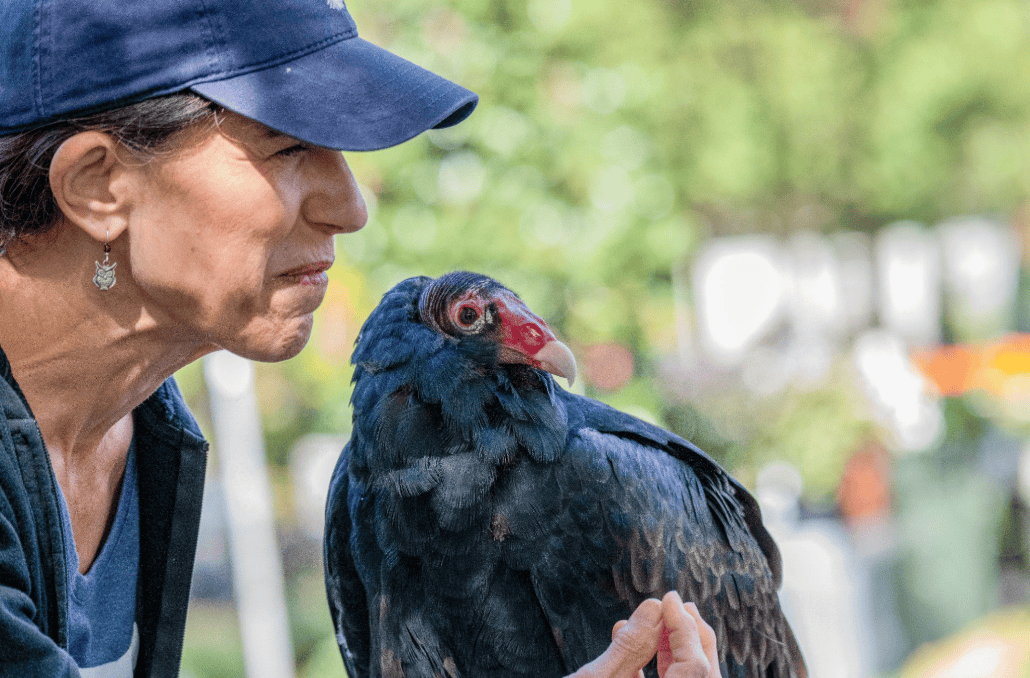
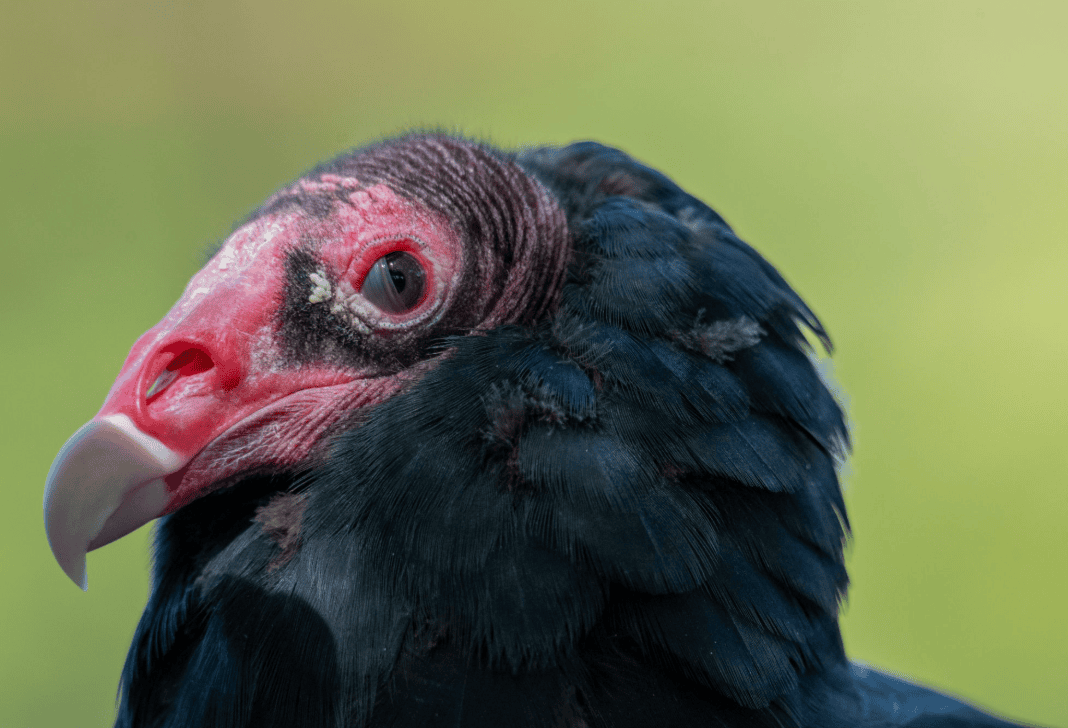
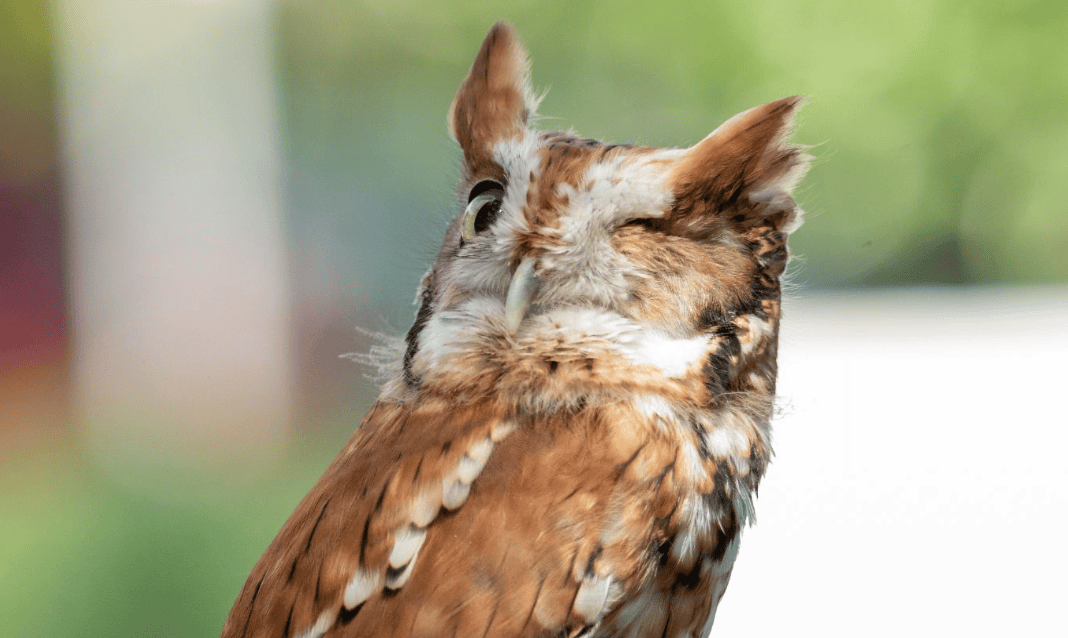
The wildlife rescue currently houses eight birds of prey: two red-tailed hawks, two eastern screech owls, one long-eared owl, one great horned owl, one peregrine falcon and one turkey vulture.
Evelyn Alexander regularly hosts raptor-centered events. Its most recent event was held Sept. 19 at Marders, an outdoor garden center in Bridgehampton.
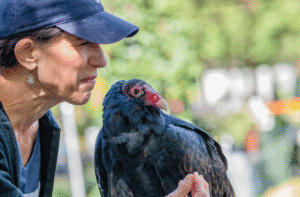
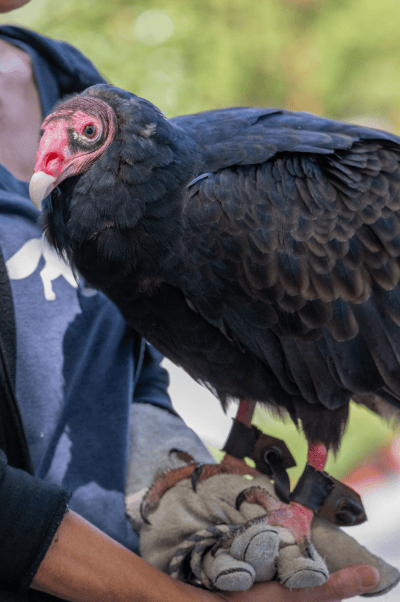
Staff brought Skittles, an eastern screech owl; Vlad, a turkey vulture; and Leona, a long-eared owl.
“My role as education director allows the public to meet our wild neighbors up close and gain a new respect for them,” Flanell said. “People love meeting the birds, and it makes them more aware of what’s happening in our local environment.”
Flanell told attendees that Vlad arrived at the rescue as a juvenile turkey vulture after being hit by a train while feeding on the tracks in Hampton Bays.
Vlad was sent to the Raptor Trust, a bird rehabilitation and education center in New Jersey. Flanell didn’t interact with Vlad outside of picking her up from the center and driving her to a release site.
“After a short time, she was hanging around a few local restaurants and people were feeding her,” Flanell said. “It made her used to being with people, and she wasn’t going off with other vultures anymore.”
The education manager found her way to wildlife rehabilitation by rescuing baby groundhogs with her husband. She brought them to a wildlife rescue center other than Evelyn Alexander.
Flanell’s coworker, Grace DeNatale, found her way to the field because, as she said, wild animals are a safe space for her.
“Wild animals need the most advocacy,” DeNatale said. “We have destroyed their homes and depleted their food. They have no shelter and no means to survive.”
She cited deer in the road, raccoons in residents’ garbage and songbirds flying into windows as examples.
DeNatale is a senior animal technician at the center and a licensed wildlife rehabilitator. She oversees patients’ care plans and develops plans for new patients.
The animal technician said the most rewarding part of her job is release day.
“You must return any adult wild animal to the spot they were found,” said DeNatale, while commenting on the biggest challenge in releasing a raptor back into the wild. “Animals, like us, have established territories. If you displace an adult, it would be like leaving you in a foreign country with no food and no communication.”
Before they can be returned to the wild, they must be rehabilitated. To DeNatale, successful rehabilitation means preserving the wild animal.
She explained that part of the process involves minimizing stress by covering the birds’ cages, speaking in a low voice and only handling the raptors when necessary.
“We are a working hospital, not a sanctuary,” DeNatale said. “We are predators whether we like it or not. These patients have no idea we are here to help them.”
The senior animal care technician estimated that nearly all the injuries among the center’s raptor patients result from vehicle collisions and gunshot wounds.
DeNatale also discussed rodenticide poisoning. She urged the public to stop using poison when trying to control rodents because it can unintentionally put raptors at risk.
“Poison the rat, you poison the one eating the rat as well,” said DeNatale, commenting on rat pesticide’s effect on the food chain.
Exploring interactions between humans and animals
Patricia Pendry, a professor of human development and graduate faculty in prevention science at Washington State University, spoke about her focus on human-animal interaction, or anthrozoology.
Pendry described anthrozoologists’ mission as conducting research and applying evidence-based approaches to enhance the well-being of humans, animals and the environments they live in.
Traditionally, anthrozoology focused on human and animal behavior.
Pendry explained that over the last 10 years, a perspective known as “One Health” has emerged. This approach examines people, animals and the environment they live in. It also includes discussion of habitat encroachment.
Pendry also highlighted the difference between caring for an animal because its existence has value and caring for it because it provides a benefit. She emphasized the importance of appreciating animals for its intrinsic worth.
The anthrozoologist also argued that teaching younger generations about the environment is important.
“Having an understanding of what these animals bring and how cool they actually are, sometimes that’s the pathway towards greater appreciation for these animals without the benefit,” Pendry said.
With experience educating the next generation firsthand, Dell Collum, a Hardwick, Mass. resident, echoed Patricia Pendry’s sentiments.
Collum has worked in rescue, rehabilitation and education for 35 years. He was born and raised in Amagansett, in Suffolk County, and later joined the Navy. When he left the Navy, Collum was “strictly all about wildlife.”
In addition to Massachusetts and New York, the 63-year-old has been a licensed wildlife rehabilitator and rescuer in Texas, Idaho, North Carolina, Wyoming, Ohio and Arizona.
With Evelyn Alexander’s permission, Collum started a nonprofit wildlife rescue, requiring him to be on call around the clock.
“It got so that I wasn’t helping animals,” Collum said. “I was like the angel of death.”
He said the cycle led to what is known as compassion fatigue, a condition that can develop when someone cares for others too much for too long, leading to depression. Eventually, he reached a breaking point and left New York.
In 2015, Collum received a call from the Evelyn Alexander Wildlife Rescue Center. They had a blind screech owl named Athena who didn’t tolerate living with other birds. Evelyn Alexander asked Collum if he would take her in.
Collum did and trained her. Eventually, he often brought her to schools and summer camps.
“I just enjoyed it because the kids loved it,” Collum said. “And when I showed them Athena, their ears listened, and it allowed me to teach them about owls and other animals.”
Collum said his rule is to reach children while they’re young, and that’s why he enjoys talking to them.
“I hear from so many parents, ‘Mr. Collum, my son came home and told me I shouldn’t be feeding bread to the ducks at the duck pond,’” he said. “I get so many of these calls, and I’m like, ‘Yeah, right on!’ This is where it starts.”