By Alexa D’Amato
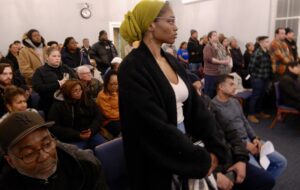
Shortly after the death of Hempstead resident Santos Edilberto Banegas Reyes at the Nassau County Correctional Center in East Meadow, protesters gathered in front of the County Executive Building in Mineola Sept. 29 to decry Immigration and Customs Enforcement’s presence on Long Island.
According to the ICE website, the federal agency is using the jail as a detention center for Long Island, which has housed over 2,000 immigrant detainees since February, after Nassau officials agreed to rent 50 cells to ICE. County Executive Bruce Blakeman also permitted 10 police detectives to work with the federal agency in arresting undocumented immigrants, according to recent news reports.
In a speech at the protest, Long Island Justice Alliance advocate Cheryl Keshner said Banegas Reyes was a construction worker before his death, which ICE officials attributed in a preliminary report to liver failure, an assertion that his family called “unbelievable.”
The protesters argued Banegas Reyes’ arrest and death provided no due process, which they argue the U.S. Constitution grants to non-citizens. They contend his arrest and those of other workers on Sept. 17 violate the 14th Amendment, regardless of their legal status.
They said they worried about the precedent that this case could set for those who are documented residents and citizens. “This is not just about immigrants. It’s about you and me. These are basic Constitutional rights to an attorney, not to incriminate yourself,” Long Island Jobs With Justice Community outreach coordinator Richard Koubek said in a speech. “Basic rights, they’re going away. They’re almost gone for the immigrants.”
The protesters called on ICE to leave Long Island. “We have to demand not only ICE out of Long Island, but we have to treat everyone with dignity and humanity,” activist and educator Sonia Arora said. She also read a poem from her students to other protesters on the steps of the County Executive Building.
The protesters campaigned for the abolition 287(g) Program, which allows state and local law enforcement to partner with ICE. According to ICE’s identify-and-arrest mission statement, this permits smaller agencies to process undocumented immigrants who are facing criminal charges and to serve administrative warrants on them.

ICE provides training for local law enforcement, which the federal agency funds. According to ICE’s announcement of the 287(g) program earlier this year, state and local law agencies can collaborate with ICE, and local officers learn about immigration law, communication across cultures and avoidance of racial profiling.
New York has not signed a statewide 287(g) agreement. Instead, Nassau is one of six jurisdictions in New York with such agreements, along with Broome, Niagara, Rensselaer, Madison and Oneida County (through the Village of Camden). Neither New York City nor Suffolk County participates.
Critics of the 287(g) Program say it destroys trust between local law enforcement and immigrants, who fear arrest and deportation. They also believe racial profiling is common, an allegation that ICE has denied.
“People are afraid to call the police, people are afraid to go for healthcare, they’re afraid to send their children to school,” Keshner said in an interview after the protest. “It’s traumatizing people. Families are being torn apart.”
Blakeman stood by his choice to sign the 287(g) agreement in a news conference in February. “I want to stress that this program is about illegal migrants who are committing crimes,” Blakeman said. “This isn’t about race. This is targeted enforcement of our laws based here in the State of New York.”
He said entering the U.S. without documentation violates federal law and said he was looking out for county safety.

According to a ICE report, Nassau is among more than 1,000 local governments nationwide that have a signed 287(g) agreement with ICE. The New York Civil Liberties Union, Hofstra Law Clinic and LatinoJustice Puerto Rican Legal Defense & Education Fund, however, filed suit against Nassau County Police Commissioner Patrick Ryder, Nassau County and the Nassau County Police Department in June, claiming Nassau’s agreement with ICE has led to racial profiling and is undermining local law enforcement.
Ryder officially signed the agreement with ICE. The suit was filed on behalf of Diocese of Long Island, the Hempstead-based Central American Refugee Center, Haitian American Family of Long Island and two Long Island residents.

Some residents at the protest expressed broader concerns about the program’s ethical and social impacts. “We’ve done a very good job at making hate not just legal but profitable, because these 287(g) agreements that the county has entered into [are] providing [the county] with income, and we’re using that income to use services that are going to perpetuate more harm and not be equitably distributed,” Hempstead resident Kiana Bierria-Anderson said. “I don’t believe this makes us safer.”
While the county does not receive direct income from the 287(g) program, it does earn revenue from renting jail space to ICE under a separate contract. ICE reimburses the county for detectives’ time spent on immigration enforcement — a cost offset, not direct revenue, according to its 287(g) agreement.
Bierria-Anderson said she came to protest ICE’s involvement on Long Island because it goes against her principles. “I have a firm set of values and beliefs, and this does not align with them,” she said. “We can’t call ourselves ‘the land of the free and home of the brave’ if we aren’t keeping people free, and we aren’t being brave with what our values are.”
Keshner said she attended the protest to support those who are afraid. “We need to step up for people who are too endangered to step up for themselves, and we need to voice that what is happening now is wrong. It’s contrary to democracy. It’s shattering our families. It’s shattering our communities, and it’s unjust,” Keshner said. “We cannot remain silent in the face of injustice.”