By Marissa Di Vita
Part one in a series.
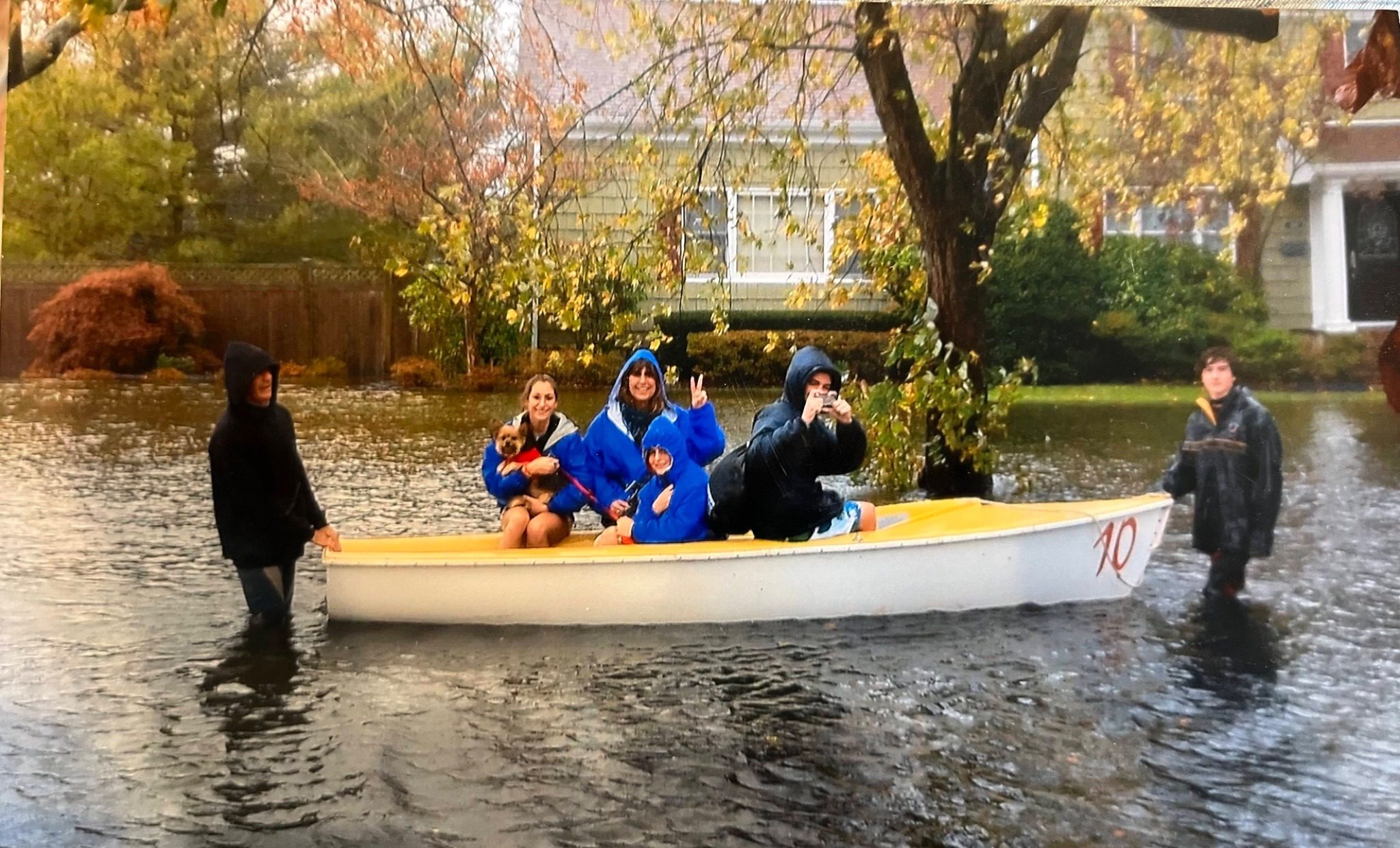
Gayle Comerford and her family in a canoe that brought them to safety outside their home on Eaton Lane in West Islip after Hurricane Sandy slammed Long Island in October 2012. Without small boats like this, residents in some areas had to wade through waist-deep water to leave their homes in the immediate aftermath of the storm.
Photo courtesy Comerford family
For many, it was like any other Monday. For residents of Long Island and New York City, it was the start of a nightmare.
The forecasts did not look good. Evacuations were ordered and residents moved their belongings higher up in their homes, preparing for storm surge, high winds and whatever length of time they might be without power. From Oct. 29 to 30, 2012, wind speeds of up to 80 miles per hour battered homes across Long Island and New York City. The full moon contributed to the floodwaters, with the high tide causing a storm surge of about five feet above normal in many shoreline communities across Suffolk County. Forty-three people lost their lives in New York City, with 53 total deaths reported across New York State, according to New York City recovery reports and the National Hurricane Center.
But the trouble didn’t end with the storm. With billions of dollars in damage, approximately 305,000 homes in New York were ravaged or destroyed, and more than 23,400 businesses in New York City alone were impacted, according to New York State and New York City recovery reports.
Power in many areas wasn’t restored for more than two weeks—or longer. While the North Shore of Suffolk County experienced coastal flooding, the South Shore was hit by severe storm surge.
Residents struggle amid the storm
Gayle Comerford of West Islip was home with her husband and four children when the storm hit. When the water rushed in fast “like a tsunami,” the family was prepared with a canoe they had found on the street and tied to the front porch the night before. Amid the chaos of the storm, the group of six paddled down the street, out of the storm surge, as the water rose three feet in their home.
After the storm, overtaxed emergency services offered little assistance to many residents displaced from their homes. The best that the Federal Emergency Management Agency could offer the Comerfords, family members said, was a hotel in Niagara Falls, approximately a seven-hour drive away.
“Nobody gave us any help at all. It was insanity. We had no place to live, so we stayed with friends for a little while,” Comerford said.
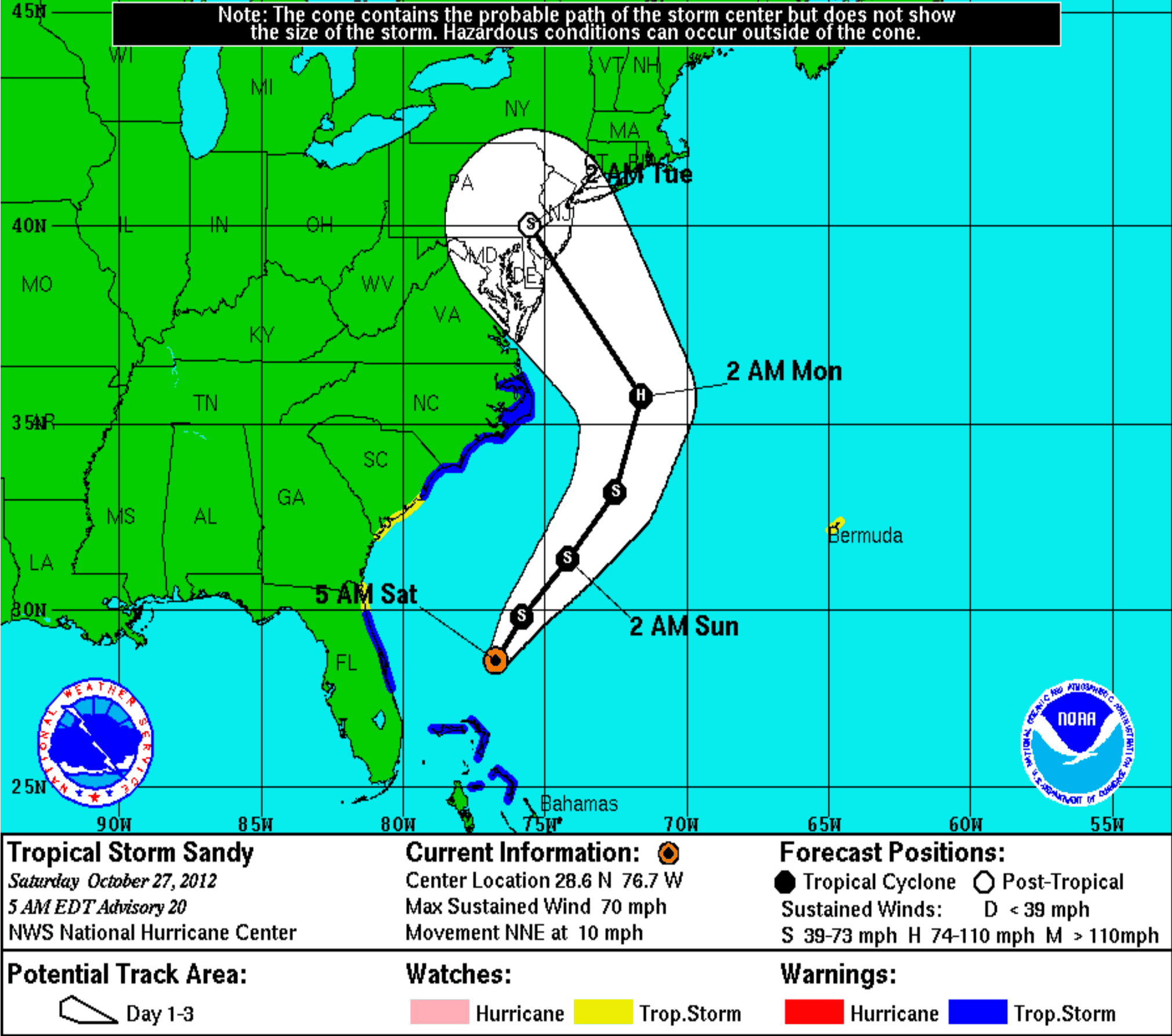
A forecast map released by the National Hurricane Center on Oct. 27, 2012, shows Hurricane Sandy’s projected track toward the Northeast before the storm devastated parts of Long Island and New York City.
Graphic courtesy National Hurricane Center
After spending three weeks in a friend’s basement, the family was given a camper where they lived while their home sat vacant for months. “Unfortunately, [the camper] was so close to getting flooded itself because the floods just kept coming up. It wasn’t like Sandy, and then it left,” Comerford said.
Comerford quit her job as a receptionist to dedicate her time to filing paperwork for FEMA, which, along with major delays and approvals from the Town of Islip, halted repairs to their home until mid-winter, when the family was finally able to leave the trailer and start to put their house back together. It was only a few weeks until they left their home again while it was raised, and almost a year passed since the initial impact of the storm before the Comerfords’ home became habitable again.
Comerford said it took about a year for life to feel somewhat normal again. She lost everything in her home, including videos of her children’s first Christmases.
After feeling the weight of losing all that she owned, Comerford said she gained a new perspective: “Things don’t mean anything anymore, just people.” She said it comes down to how you feel about your favorite blanket or sweater versus how you feel about your favorite person. Comerford wishes people who didn’t go through Sandy understood how fortunate they were, and how kind people were to her and her family.
In Lindenhurst, other coastal homes sustained significant damage. Ashley Wallace found herself in her childhood bedroom with her parents waiting out the storm when a neighbor’s boat crashed through the house, docking itself in the garage.
She said her dogs had to learn to relieve themselves on the roof of a shed that had landed on the Wallaces’ driveway.
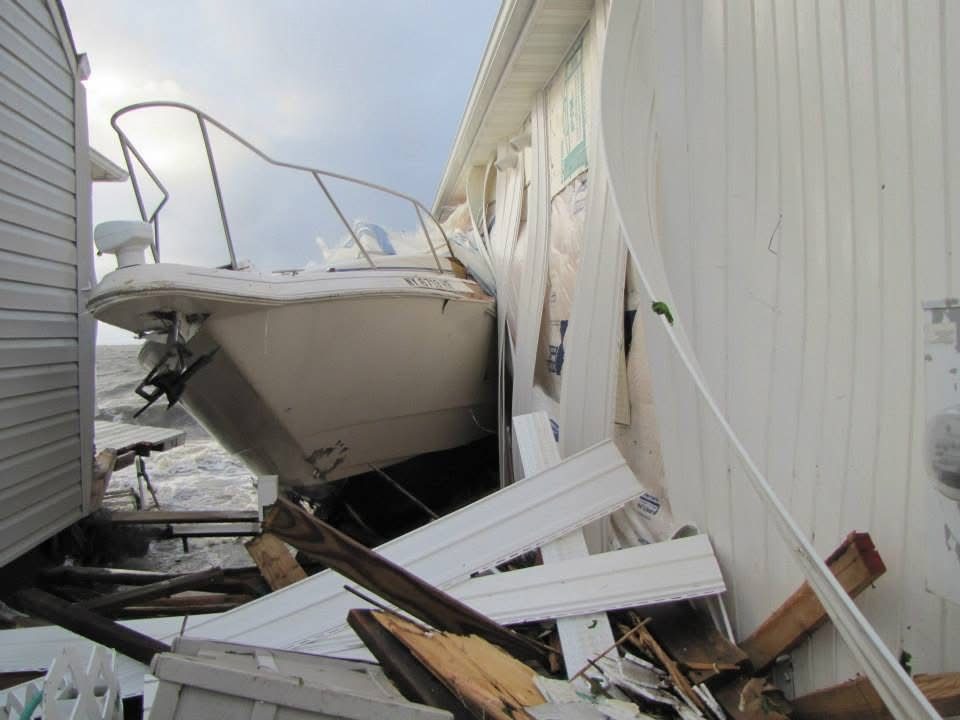
A boat that crashed into the attached garage of Ashley Wallace’s home on Bayview Avenue West in Lindenhurst during Hurricane Sandy in October 2012. Wallace said the storm surge carried the boat directly into the structure as her family waited out the storm inside the house.
Photo courtesy Ashley Wallace
After the property was restored to its original beauty, the house was purchased by New York Rising, a program run by New York State at the time to buy houses in flood zones and demolish them.
Officials’ perspective
Edward Schneyer, now the resource management officer, served at the time of Sandy as the director of emergency management at the Suffolk County Office of Emergency Management. The OEM station in Yaphank served as the main command post for operations during the storm and the subsequent recovery. Schneyer and his team were responsible for monitoring the storm and maintaining the emergency operations center for all of Suffolk County, ensuring that those in flood zones were notified to evacuate and could receive assistance once recovery efforts began.
“In Suffolk County, we have 1,100 miles of shoreline… [including] all the rivers and lakes…” Schneyer said. With the storm coming up from the south across the county, Suffolk’s South Shore faced the brunt of the storm. Schneyer said 11,000 of the 21,000 damaged homes were flooded with “anything from one to six feet of water in the house,” with homes on Fire Island and the Barrier Islands most impacted, serving as a break wall for and minimizing damage on the mainland.
Rich Schaffer, Town of Babylon supervisor since early 2012, said residents were rescued in the buckets of payloaders after floodwaters became too dangerous for firefighters. He said parts of West Babylon, Copiague, Amityville and Lindenhurst looked like a “war zone,” with boats jammed between trees and houses washed into the bay.
The storm was a shock, and Schaffer said it was important to him that people didn’t continue staring at their wrecked belongings on the side of the road. Town workers acted as quickly as they could to clean up debris left on the curb by homeowners.
“FEMA came in and [was] working through [the Town of Babylon] and Suffolk County to start outlining how people would be able to get emergency assistance,” Schaffer said. “…and then we had to work on getting PSEG to turn the lights back on.”
Town of Babylon officials worked to clear downed trees from wires and repair blown transformers. South of Montauk Highway, they worked with the building department to ensure all electrical systems were inspected before PSEG turned the electricity back on in homes where saltwater had fried their systems.
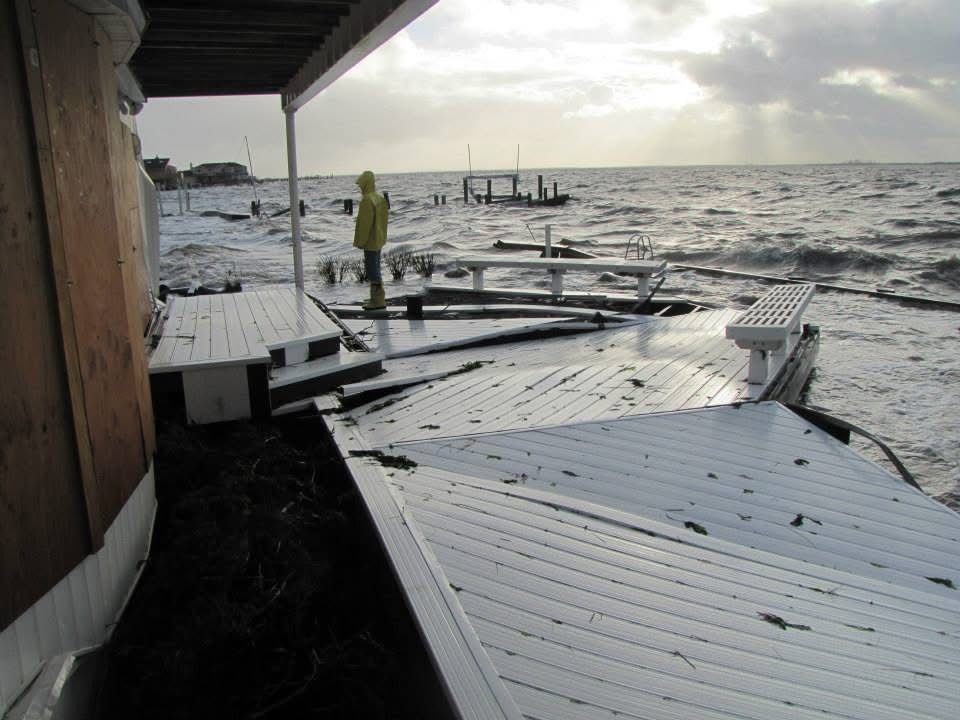
The backyard of Ashley Wallace’s home on Bayview Avenue West in Lindenhurst in the aftermath of Hurricane Sandy in October 2012. Wallace said debris was scattered across the property, and floodwaters nearly covered the boat pilings on the dock.
Photo courtesy Ashley Wallace
He said Hurricane Sandy caused massive beach erosion, especially at the Barrier Beaches, including Gilgo Beach and Cedar Beach. Soon after the storm, the Town of Babylon had to work with the federal government to coordinate a sand replenishment program to rebuild coastal areas and fortify the barrier beaches so they would be protected them from future flooding and storms.
A group of people formed a program called Adopt a House after the storm. Volunteers went house to house, cleared out saltwater and muck left behind by the storm surge and organized personal belongings for those who could not clean out their homes on their own, such as older adults or individuals with disabilities.
About 3,000 families in the Town of Babylon were displaced by Hurricane Sandy. Many residents didn’t have the resources to repair their homes. Some lived paycheck to paycheck, and many spent months fundraising.
Congress authorized the federal government to award New York State funding, and the Town of Babylon helped determine the best way to distribute it to help people return to their homes. Schaffer said the initial emergency response period lasted about 90 days after Hurricane Sandy hit Long Island, and the recovery process as a whole required five to seven years.